"The tragic reality is that very few sustainable systems are designed or applied by those who hold power, and the reason for this is obvious and simple: to let people arrange their own food, energy and shelter is to lose economic and political control over them. We should cease to look to power structures, hierarchical systems, or governments to help us, and devise ways to help ourselves." - Bill Mollison
Forcing = the art of raising plants, flowers, and fruits at an earlier season than the natural one, as in a hotbed or by the use of artificial heat.
We do not totally rely upon the outside garden for greens in the cold months, forcing is used upon a variety of plants to help provide for us. To us, forcing means allowing certain plants that we have stored in our root cellar to get enough warmth that they will start to grow new edible leaves again.
In Victorian kitchen gardens of old it was popular to force belgian endive, sea kale and rhubarb. Belgian endive was always forced in the dark and the new non bitter shoots were often served at meals.
In the fall we pot up belgian endive
various beets,
turnips, kohlrabi (we call them martians),
and celery
that are stored in our basement/root cellar. As needed, we bring some of the plants upstairs and keep them next to a window so they get light and the pale new growth that has sometimes already started is allowed to change into a more natural healthy color.
The leaves are then cut and used in salads. The root or stalk on all of these is also used at that point. Most of these plants will send out more growth but it will not be as vigorous and the root will become less palatable. This also works well for onions that have started to spoil, instead of the mulch pile we can usually get them to send up some fresh shoots first by simply providing warmth and a little dampness to the roots.
We prefer to eat the leaves after they have been in the light, some of them (especially the endive) will be somewhat bitter tasting but perhaps much more nutritious. Our favorites are the endive and beets. Our endive roots are much smaller this year due to having been replanted in July after a hail storm destroyed them.
Here is a great YouTube video series on Victorian kitchen gardens. The last part of the video talks about forcing rhubarb and sea kale.
Has anyone else tried this, and if so with what plants and results? I am thinking of growing sea kale for forcing this year, I would love to hear others thoughts on this plant.
This time of year our basement resembles a strange nocturnal garden full of potted plants whose foliage we rely on to help sustain us through the winter months. Just before the ground started to freeze this fall we potted up Belgian & Batavian endive, parsley, Swiss chard, celery, red sorrel, and other greens. We are even experimenting with rhubarb, arugula, and various lettuces this year. Some of these (not the Belgian endive) we leave outside, after potting, for as long as possible so they can more easily adjust, via new root growth, to their enclosures and receive the last few rays of sunlight before entering the gloom of our root cellar/basement for the winter.
Most of these plants are brought upstairs into the light a few at a time starting in January to help supplement our daily salads. This is especially helpful on days that the weather or time prevents us from gathering greens from under our row covers. This week finds the plastic on all of our covered rows firmly secured to the ground by a thick layer of ice making it difficult to remove the covers without tearing them and was a good reminder that I needed to start encouraging growth from our potted plants. Within a week of sitting next to a somewhat sunny windowsill the plants begin to quickly green up and grow. Many of them can be cut numerous times before needing to be replaced.
While our Belgian endive roots were much smaller this year due to the fact that I did not thin them properly (again) we have simply stuffed more into each container enjoying the leaves all the same. The endive does not produce a very good second crop after the first cutting but the roots can then be used for coffee, tea, or roasted chicory chips.
Belgian endive beginning to put out new shoots, they will become very bitter once subjected to sunlight but possibly more nutritious.
This Batavian endive's blanched color will transform to dark green after being exposed to light for a few days.
Parsley is an excellent cut and come again crop that not only thrives in the basement but outside under our row covers as well. It seems to maintain it's greenness long after the other plants have begun to pale in the darkness. I will be growing Hamburg, a root parsley, this year and think/hope it might also perform well in this unnatural environment.
They don't look like much now but I just brought these plants upstairs and trimmed all the bad leaves off, they should start growing soon.
While all but the smallest leaves of the Swiss chard outside in our covered rows have finally succumbed to the weather and turned to mush after numerous freeze and thaw cycles those in our cellar live on. The potting up of Swiss chard is a little new to us in that we have only been experimenting with the forcing of this plant for a couple years. I have noticed that the more mature chard with a bigger root system hold out much better than the younger plants and will provide us with at least a few good cut and re-grow cycles before they are spent and begin to focus on bolting to seed.
I left a few of the smaller leaves on the chard but cut most of them back to compensate for any root damage caused during the potting process. After two months in the dark they are still maintaining their color pretty well.
Our hybrid Utah celery performs much better in the basement garden than its open pollinated kin Giant Red whose stalks tend to be more hollow and can get a little tough as the months progress. We find the new smaller shoots are best off this variety whereas the Utah's bigger shoots are better able to maintain a firm crunchy texture. This year I will be growing three new types of open pollinated celery in the garden in hopes of finding more varieties for winter forcing. I would like to try Safir, Par-Cel, and Ventura. That said, I still love my wild and temperamental Giant Red celery because of its cold hardiness and unusually strong flavor and will probably always save a spot for it in the garden.
We do not normally bring our celery upstairs due to the size of the containers and simply harvest shoots as we need them directly from the root cellar where they continue to put out new, albeit pale, growth.
Occasionally we separate a few of our more gnarly less palatable kohlrabi to bring upstairs and after being subjected to sunlight will harvest the greens. New shoots will then form at various places on this bulbous vegetable's "stem" allowing for numerous harvests. When you use a beet or kohlrabi in this manner the vegetable itself will become tough but can still be used as a food source for animals. Although I did experiment with beets and found that they were still pretty edible if used directly after the first forced growth had been harvested. The bigger the root or bulb vegetable the bigger the greens.
To control this leafy growth on my "good" kohlrabi, the ones whose thick stems I wish to eat, I will either keep them in a cooler part of the basement or am simply diligent in pinching back any growth before it takes hold, much the same as with my potatoes and carrots in the early spring when the cellar begins to warm a bit.
Arugula and the "frilly lettuces" as I like to call them seem to be holding up pretty well, time will tell the outcome of these and decide whether they are worthy of the indoor garden. Although, so far, I have been surprised at how long these lettuces have retained their green color in the gloom of our root cellar. I only potted up thirty 8" pots of the lettuce and arugula for this experiment, but could do many more next fall if we are pleased with the results. My fear is that they will immediately bolt once introduced to a warmer environment...I shall soon find out.
Lest I forget to mention them we also force, to some degree, turnips (the ugly ones), onions, dandelions, and my favorite forced veggie...beets. Tending hundreds of potted plants in ones basement may seem like quite the ridiculous chore but if it keeps me out of the grocery store I am more than game for the task. With any luck, this basement garden alone will provide us with a couple large salads every week during our most challenging months. Gardening never really ends around here it just takes on different, sometimes unusual, forms.
For more of my scribblings on forcing check out last January's post Forced To Provide.
Penelope giving my lovely wife instructions on how to properly pack endive roots ↑
With a little help from our trusty assistant and self-proclaimed Master Gardener, Penelope, we were finally able to get some of the endive pulled and packed into pots for storage. Little red headed Penelope has been a step ahead of the rest of the flock since day one. We can take her into the garden without worrying about what she'll get into as she just likes to keep us company. This never works out too well with the other birds who immediately seek out the garden's forbidden fruits. They must be very jealous of her as they are only able to watch from afar as we dote on her. She is a very affectionate girl, the minute you kneel down she will hop onto your leg seeking attention...chicken love, it's a Northern Idaho thing.☻ If these crazy birds ever get setty I hope it's her as she is by far the most intelligent of the bunch, and that's not saying much.
After carefully pulling the endive so as not to break the roots, we cut all the greens off and put them into a large pile slowly feeding them out to the chickens over the next few days. Piled up like this the waste greens will stay fresh for over a week in fall's cooler temperatures and provide the birds with a valuable source of nutrition. The roots are then layered into small pots for storage. I finally figured out that if you lay the pot on it's side it is much easier to place the long rooted endive into them...it was Penelope's suggestion of course. I will take these pots out of our root cellar and into the much warmer upstairs one at a time and enjoy the forced greens in the middle of winter. The roots can also used as a coffee substitute - Poor Man's Coffee.
Forcing = the art of raising plants, flowers, and fruits at an earlier season than the natural one, as in a hotbed or by the use of artificial heat. In our case this applies to winter salad greens - Forced To Provide.
A substitute for this root, both for forcing greens and a sorry cup of dried root coffee, is the common dandelion.
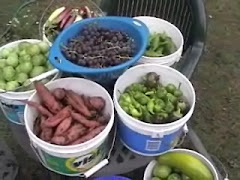
The weather was not our friend this year but with a little luck and lots of work we managed a fairly good harvest. September - November are the months we work on pulling the majority of our crops out of the garden and getting them ready for the root cellar, freezer, dryer, etc...
The root cellar is our basement, we are lucky to live in an early 1900's cottage type house with a large cement basement that stays fairly cool year around. We keep potatoes,
carrots, beets,
kohlrabi, cabbage,
Belgian endive,
parsnips, turnips, apples, celery in the root cellar because the temperature and humidity is just about right for these crops. Squash,
onions,
and some of the tomatoes,
tomatillos, peppers,
eggplants are all kept in various parts of the house as it is less humid and has a more varied temperature range. Some of the tomatoes (Burpee Long Keeper) last all the way until spring if we are lucky. We also bring some pepper plants live in pots into the house in order to have peppers all the way into December.
We dry apples, pears, plums, tomatoes, walnuts, herbs, garlic, morel mushrooms, and beans.
Some are dried in the greenhouse and porch, but we do rely upon a food dryer for most of them as we have a very humid fall in our area that is not conducive to drying food.
The only herbs we freeze are basil and cilantro. We pick them, wash and dry the leaves as necessary, mix in a big bowl with a little olive oil and then pack them into freezer bags. This seems to make them keep better and allows us to easily separate the frozen leaves as needed. Tomatoes, tomatillos, ground cherries, and peppers are also frozen or made into sauce. Broccoli, beet greens, kale, garlic scapes and basil are made into a pesto and served over pasta. We also freeze some of the kale and use it in soups...it really freezes well and is an excellent addition to soups, omelets, or stir fry.
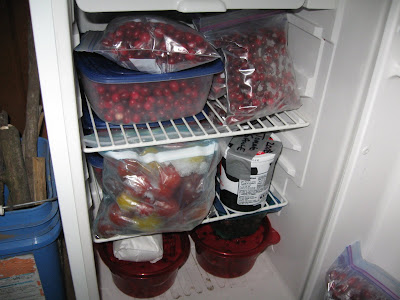
We freeze most of our berries
but are looking for alternatives to this as the berries make up about 60% of our freezer space. We had to use these two smaller freezers as a backup because our big one overfloweth, I suppose this is a good problem though , it's better to worry about not having enough space than not having enough stuff to fill my spaces.
Our goal is to eventually get away from the whole freezer thing, but we have not come up with a good solution to keeping almost 45 gallons of berries that we grow and gather from the wild each year.
If anyone has come up with a way to store berries in their natural state we would love to hear about it. We use them in smoothies for breakfast and would love to do away with freezing them but don't want the added sugar that canning would involve.
Below is a list I made several years ago to remind me not to forget any of my fall duties. The dates change according to the weather.
HARVEST SCHEDULE:
7/1 - 10/1- dry or freeze (basil & cilantro) herbs and make basil, broccoli pesto
9/01- pull beans for drying in greenhouse
9/15-25 - pull tomatoes (tomatoes in house for quick ripen and basement for slow ripen) and most peppers, tomatillos, ground cherries, and eggplants, pot up peppers to overwinter
9/15-25 - pick summer squash, check pear trees
9/25-10/1- pull and dry on porch, potatoes, winter squash, zucchini, cabbage, kohlrabi ( cabbage kohlrabi only if fearing frost, best to wait as long as possible) (remember that last November got really warm and I pulled cabbage, kohlrabi and potatoes to soon)
9/26-10/20- pick plums
10/1- get row covers ready
10/15-11/15- pot up for forcing, beets, dandelions, Belgian endive (do endive last), broccoli, cabbage plants, asparagus, parsley, and chard ...remember to bury extra greens in bags for the chickens
10/30-11/30- pot up rhubarb ( allow to frost for 3 weeks before bringing in ...see plant notes on forcing rhubarb)
10/1/-10/30- apples and cranberries
10/15- 11/01- pull carrots, pot up leeks, clean garden and greenhouse
Warning -“The critical opinions of a writer should always be taken with a large grain of salt. For the most part, they are manifestations of his debate with himself as to what he should do next and what he should avoid.” - W. H. Auden
The above quote can be considered my disclaimer as I am somewhat of a boob when it comes to discussions on animal husbandry. Give me a potato, tomato, or even a funky climbing trombetta squash to talk about and my confidence level is fairly high...chickens, not so much. That said, we have somehow managed to keep our flock healthy and thriving for a few years and are only now faced with a slow down in egg production forcing us to contemplate a few new additions to the gang.
One of our future goals is to become more self-sustainable when it comes to feeding our fine feathered friends. We think that this objective could either be achieved by once again selling enough eggs to pay for the birds feed and/or growing all of the foods that a small flock might need to meet their nutritional requirements. My plan is to one day soon set aside a small section of land that we will use to grow enough corn and wheat to feed a flock of 15-20 chickens whose diet will also be supplemented with as much garden produce as we can get them to eat. I figure that this might be possible on about 1/4 an acre...we shall see and I shall share.
These carrots, mangles, beets, potatoes, squash, apples, and sunroot tubers are being grated for the chickens.
At this point we are still buying most of the grain products that we feed our flock but do go out of our way to augment their diet with as many home grown food stuffs as possible. This makes a huge difference in the amount of store bought grains they consume. Right now our birds have around one fenced acre of forest and field in which roam about foraging for bugs, grass, and anything else they might find...this also helps with the feed bill.
The flock heading out into the cold...they hate being cooped up even more than they dislike the snow. Their pen is always open during the day so they can come and go as they please.
Every couple days during the winter months we grate and then steam cook a wide variety of vegetables from our root cellar for the chickens. A portion of this is then fed to them late in the afternoon each day to provide enough carbohydrates to help them stay warm at night. In addition to root vegetables the birds are provided with alfalfa hay when they can't forage for grass and weeds due to the snow and I also try to obtain any "less than perfect" greens from the winter garden rows for them while picking our daily salad.
The chickens get a flake of alfalfa hay every 3 days when their free range is covered with snow.
Their eggshells are saved, dried, crushed, and added back to the feed to help provide them with enough calcium for all those eggs we no longer get. Every couple weeks after I have cleaned out the wood stove the "cool" bucket of ash is left in the pen for them to peck at...they really seem to like the ash and it no doubt adds some beneficial minerals to their diet. I do know that the ash contains some calcium because we add all of Rowdy's (the dog) and any other bones we might come upon to the fire. When it is time to clean out the fireplace any ash remaining in the bucket is then spread on the garden and replaced with the new stuff. Wood ash can also be dumped in a pile so the birds can use it for dust bathing purposes during the winter, although we don't do this as their pen has plenty of soil in it. Obviously, we are very careful that nothing other than wood and the occasional bones go into the fireplace.
I built our chicken house so that it could easily accommodate 30-40 birds, although we have never had that many. Their house is built right into the barn and has three adjoining rooms, the one pictured below is where they sleep and lay eggs.
As I've mentioned in a previous post an oil heater and bird bath warmer are ready to use during January when the temperatures sometimes drop into the negative digits for a couple weeks. The heater is surrounded by chicken wire just in case someone decides to try roosting on it...so far that has never happened.
There is nothing better than a nice dust bath on a sunny winter's day...dirty birdies.
Here is an interesting excerpt from Countryside Magazine on feeding animals from one's garden:
"While growing small amounts of grains will be fun and instructive, you'll soon see why farm folk welcomed mechanization. But what about those crops that got left behind in the process?
The leader is probably the mangel, or mangold, or mangle-wurzle or stock beet. These are fun to grow: they'll amaze your friends and neighbors.
The roots reach fantastic proportions. . . two feet long and more. Don't worry: they grow mostly above ground You won't need a backhoe to dig them.
At one time mangels were a staple feed for dairy cattle, even in the U.S. They were displaced because the growing of other feeds was more easily mechanized. . . and because of the research into and improvements in silage. (Some writers maintain that if as much work had gone into root crops as was invested in silage, root crops would be the more common today.)
After harvesting, cut off the tops and store the roots in clamps-rudimentary root cellars. Dig a pit, put the mangels in, and cover with enough straw and soil to keep them from freezing.
We once had a Jersey cow that ate mangles whole, just nibbling on them like people eat apples. But conventional wisdom says cows can choke on these beets, so they must be cut into bite-size pieces. If you want to feed mangels and you're lucky, you might still be able to find a beet-cutter hidden away in an old barn. Failing that, you might study one in a farm museum and replicate it. . . or devise your own. On a small scale, of course, they can be chopped with a large butcher knife or machete.
Other root crops include the aforementioned turnips and carrots. Turnips have made a recent comeback among some shepherds. Planted in pastures, the sheep can harvest them themselves. (Turnips are said to produce off-flavor milk if fed to cows or goats.)
Carrots require more work to harvest, but if you have good, sandy carrot soil they're certainly worth considering. Store these in clamps, like mangels.
Jerusalem artichokes have also been highly touted as livestock feed by modern homesteaders. This member of the sunflower family produces stalks and leaves that are relished by cows, sheep and goats. Any animal (including humans) will eat the potato-like tubers, but that involves a lot of digging labor for little reward. We have found, however, that pigs enjoy both the labor and the rewards.
And what about potatoes? At first blush it might seem like some kind of a crime of waste to grow potatoes for livestock feed, but why is that any different than growing corn for them? Potatoes were once a common stock food, and culls are still used in potato-growing regions."
Gazing out the window I watch the last of the leaves fall from the trees reluctant to admit this year's gardening season is really over. Weather made it our toughest year ever yet we have stored up enough to feed us through the long months that lie ahead.
An unrelenting North Idaho winter had us shoveling snow in May to allow for the planting of seeds. We sadly stood and watched under the barns tin roof as thunderous hail stones pelted our newly established crops into mush on the first of July forcing us to replant over half of the garden. August windstorms took out the runner beans, which were propped back up, more securely this time, and they went on to exceed our every expectation providing us with many gallons of fresh and dried beans.
At the same time the corn was once again flattened so we constructed a rope grid to hold it up. Unfortunately between the hail and wind the corn didn't fare as well as the beans and it became fodder for our chickens. Lucky chickens. Aphids, leaf miners, and slugs haunted our salad greens and we were forced to cut many of them back in order to regain control over the bugs.
Fortunately the chickens like them better with bugs...again, lucky chickens.
We share a sense of accomplishment and pride that we did not give in to defeat and persevered to endure whatever came our way. We took it on as a personal challenge to respect mother nature's unexpected and at times irritating ways but refused to give in - whatever she threw our way we came back with a fury of our own. Here are some personal notes for the first half of July.
Garden notes and observations 2008:
07/01/2008 65-90° Day started out great, sunny and nice, 6:00 PM massive thunderstorm with large pounding hail - laid waste to garden. Looks like we get to start all over again - too bad it's already JULY!! On the bright side, we can go ahead and pick some of the peppers we have been wanting because they are laying all over the ground.
07/09/2008 56-90° Well now I know that plants that have been totally demolished by hail and rain will continue to grow...carrots sprang back the fastest with new growth and you can hardly tell anything happened to them, green beans put out new leaves fairly fast, squash and zuc are starting to put out new growth also. Peas are recovering still and the cucumbers are slowly getting new buds...I did a lot of seed re-plants on those and they are all coming up now. Broccoli (especially peacock), cabbage, and brussels still look pretty bad but are alive. Tomatoes are starting to regrow fairly well...potatoes look OK and seem to be putting out new leaves...good thing I planted so many...also the beets are starting to grow new leaves. My biggest concern is that the stress of hail and heat is going to cause chard and kales to bolt prematurely....
07/14/2008 43-80° Windstorm came and knocked my already struggling peas in half...guess I will continue with re-plants and crossed fingers today....after I clean up the mess of course.
Weary of the world and its illogical ways my wife and I have chosen a path towards self-reliance in all aspects of our lives. Our main focus is on growing and gathering our own food. We hope to use this blog as an avenue to share with and learn from others with similar interests.
The Good Life (click↓)
"To forget how to dig the earth and to tend the soil is to forget ourselves." M. Gandhi
"Deep inside everyone of us is a call to the wild. Much of the impatience, discontent or violence around us is due to a lack of opportunity to reconnect with where we came from. For sanity and generosity of spirit, we should be able to witness nature at its unceasing, rejuvenating work." - Abdul Kareem
On Permaculture, Edible Landscaping and Garden Plants
"The fair-weather gardener, who will do nothing except when the wind and weather and everything else are favorable, is never master of his craft."--Henry Ellacombe
"Subsistence defines us. We battle the elements and sometimes risk our lives for the foods we crave. It is not an easy life, but it is ours." -- Arthur Lake, Kwigillingok Tribe
"As nightfall does not come at once, neither does oppression. In both instances there's a twilight where everything remains seemingly unchanged, and it is in such twilight that we must be aware of change in the air, however slight, lest we become unwitting victims of the darkness." - Justice William O. Douglas

 various beets,
 that are stored in our basement/root cellar. As needed, we bring some of the plants upstairs and keep them next to a window so they get light and the pale new growth that has sometimes already started is allowed to change into a more natural healthy color.
 The leaves are then cut and used in salads. The root or stalk on all of these is also used at that point. Most of these plants will send out more growth but it will not be as vigorous and the root will become less palatable. This also works well for onions that have started to spoil, instead of the mulch pile we can usually get them to send up some fresh shoots first by simply providing warmth and a little dampness to the roots.
 and celery


 Our goal is to eventually get away from the whole freezer thing, but we have not come up with a good solution to keeping almost 45 gallons of berries that we grow and gather from the wild each year.


 An unrelenting North Idaho winter had us shoveling snow in May to allow for the planting of seeds. We sadly stood and watched under the barns tin roof as thunderous hail stones pelted our newly established crops into mush on the first of July forcing us to replant over half of the garden. August windstorms took out the runner beans, which were propped back up, more securely this time, and they went on to exceed our every expectation providing us with many gallons of fresh and dried beans.
 At the same time the corn was once again flattened so we constructed a rope grid to hold it up. Unfortunately between the hail and wind the corn didn't fare as well as the beans and it became fodder for our chickens. Lucky chickens. Aphids, leaf miners, and slugs haunted our salad greens and we were forced to cut many of them back in order to regain control over the bugs.
 Fortunately the chickens like them better with bugs...again, lucky chickens.
 We share a sense of accomplishment and pride that we did not give in to defeat and persevered to endure whatever came our way. We took it on as a personal challenge to respect mother nature's unexpected and at times irritating ways but refused to give in - whatever she threw our way we came back with a fury of our own. Here are some personal notes for the first half of July.