"The gardening season officially begins on January 1st, and ends on December 31."- Marie Huston

I like Marie Huston's words. Gardening does not really have to come an abrupt halt as nature ushers in shorter days and colder temperatures but can continue right on through with a little thought towards what is being grown and how to protect it from the harshness of the weather. November going into December sets the stage for our ventures in winter gardening, often bringing with it frost, frozen ground, and snow. While much of the garden area lies dormant this time of year we are fortunate to still have a nice amount of tenacious, nutritious, and absolutely delicious edible plants at our disposal.
Experience has allowed us a better understanding of our ability to have a stable amount of fresh food available from the garden, with any luck, 365 days a year. Over time we have added an excellent selection of plants to our winter gardening portfolio, eventually figuring out that, in our gardens, diversity is the key to success. On any given year the winter weather and temperatures (
USDA hardiness zone 5b) can fluctuate quite dramatically, some years are cold and dry others slightly warmer with lots of snow or more often it is a mix of both. In the winter of 2008/09 and 2010/11 we had massive amounts of snowfall while 2009/10 left us with none of this insulating coverage, only rain. All of these weather variances seem to affect individual cold hardy plants differently.
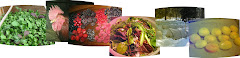
Mixed winter greens in the fall through early winter transition of 2008/09.


As mentioned in previous posts, when subjected to colder conditions some plants are actually able to concentrate or increase their sugar content which in turn serves them as a sort of natural antifreeze, helping them to withstand frosty and freezing conditions for extended periods of time..makes them taste better too. The slower the weather cools off the better the plants are able to acclimatize in this manner. It is not so much the chilly weather that will wear on these plants but all of the other elements combined such as cold, rain, snow, and wind that tends to break them down on a cellular level much faster than the cold alone. A simple protective cover makes a world of difference.
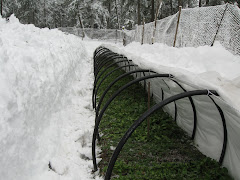
We use plastic covered hoops and cold frames over our slightly raised beds to help protect plants in the garden. This is nothing new, as far back as premedieval Rome (in a world without plastic) it has been rumored that linen cloth was soaked in tallow, resin, or linseed oil causing it to become translucent and thus allowing for both light and protection against the cold for both plants and people. Thin sheets of the mineral mica and Selenite were also used to protect plants in ancient Italy.
"Also, if it be worth the while, little wheels may be put under larger vases, that they may be brought out with less labour, and harboured in the house: but, notwithstanding, they ought to be covered with glasses, that in cold weather also, when the days are clear, they may be safely brought forth to the sun. By this method Tiberius was provided with cucumbers almost the whole year." - L. Junius Moderatus Columella AD 4-AD 70 (my take on the 1745 English Translation of
De Re Rustica page 495 & 496.)
Some of this year's young red and green Italian chicory

Listed below are plants that we have found to be very cold hardy. Of course, on any given year some of these plants will thrive while others will fail depending upon the conditions nature provides them. The timing of when to plant is also important, too soon and they might bolt to seed or grow too large to fit under our covered rows and cold frames, planted too late and they will not mature to a desired stature. This particular facet has a lot of trial and error involved as each individual garden and the plants contained therein are so very different.
In our garden the plants are grouped in those direct seeded or transplanted in the spring (April-June), summer (July-August), and late-summer (mid August-early September). We do not have set dates for planting as the weather dictates this for us. For example, if it is extremely hot and dry in mid August I might wait for a few cool, cloudy, rainy days before planting my spinach. Putting the seeds in the fridge a couple weeks in advance also helps greatly with warm weather germination.
More early evidence of lettuce, chicory (succory), and other greens being grown all year round -
"After that the Romans began to devise a means of growing them at all seasons of the year, and even preserving them, for they were used in pottage as well as salads." -
Hardwicke's science-gossip: an illustrated medium of interchange and Gossip for Students and Lovers of Nature, Volume 13 page 102
Cold Hardy Greens That We Grow -
Arugula - Including perennial Sylvetta and Grazia. Perennials planted in early spring, annual varieties late summer.
Asian Greens - We used to have good luck keeping Boc Choy well into the winter but have not grown it in recent years. That said, I do hope to focus more on this type of green going forward. Planted mid summer.
Kitazawa Seed Company would appear to be a good source for a wide selection of Asian greens...I will be ordering from them for the first time this year.
Beet Greens - Many of the younger beet greens, before the roots ball up, especially those of Bull's Blood beets, are very cold hardy. Planted mid summer.
Blackberry - With leaves remaining green, often throughout the winter, this plant makes for a wonderful tea leaf or medicinal herb...excellent source of easily assimilated calcium.
Borage - Planted in the late summer and used as a salad green this plant holds up surprisingly well to freezing conditions.
Brussel Sprout - While we rarely are able to actually get any decent "sprouts" from our brussels I have noticed that the smaller plants hold up to the cold quite well managing many freeze and thaw cycles...we use them for their greens and early winter chicken food. Planted in the spring.
Cabbage - Savoy cabbage like Melissa are quite cold hardy, easily surviving temperatures in the low 20°'s and well into December in our garden. I'm experimenting with later/mid-summer planting times as I can see the potential for them to survive all the way through the winter. Just yesterday I picked some perfectly fine small headed red Ruby Ball cabbage that were frozen solid just days before. Planted in the late spring.
Calendula - There is (was, it has since melted as the temperatures have warmed) lots of snow on the ground as I write this and we have had numerous 20° something and below nights now...even so there is a calendula blooming under one of our row covers. I should involve them more in our winter garden as the greens are edible and the plant is obviously fairly cold hardy.
Celery - Thinner stalked celery seems to survive the winter under row covers fairly well, we have had luck with Varsity, Giant Red, and Parcel. Last year we kept a whole 4 x 8' row of mostly Giant Red alive all winter under a row cover and some of our Parcel survived with nothing but snow as insulating protection. Transplanted in the spring.
Chard - As with the beet greens we have had lots of luck overwintering younger Swiss Chard plants but not so much with the older/larger ones. Planted mid summer.
Chervil - A wonderful addition to the winter garden, ours get a red hue after a few months of cold but still retain that wonderful liquorice flavor. Planted mid summer.
Chickweed - More than a mere weed this plant is a nice refreshing addition to our winter salads...the chickens like it too. Pretty much plants itself.
Chicory - We have had great luck overwintering Frisée, various radiccio, Belgian and Batavian endive, Italian chicory (Catalogna), and even the common dandelion. For winter greens, Catalogna, Batavian, and Frisée are planted in mid summer all others in the early to late spring.
Collard Greens - The young plants thrive in the winter garden but are, unfortunately, especially attractive to slugs.
Cress- Holds up fairly well if kept under cover. Planted mid summer.
Curly Dock - A fantastic spinach substitute. We are overwintering this for the first time in a covered row this season and have high hopes for it's ability to provide really early spring leaves if protected from the elements.
Herbs - Common household herbs such as thyme, oregano, winter savory, some varieties of sage, lovage for early spring greens, French tarragon (dormant during winter), and many members of the mint family all manage the winter quite well, especially if they are covered.
Hesperis(Dame’s Rocket) - Very hardy plant that we are learning to make much better use of as a winter green. Not to be mistaken for another hardy short lived perennial flowering plant called foxglove "Digitalis" that might, as my grandson says, "kill you to death" if eaten accidentally and in any quantity. Use young plants or pruned older ones. Planted early to mid summer. Read more about this super tenacious plant
here.
Kale- Along with turnips this is the plant we count on the most for a steady supply of winter greens. We have had luck with White and Red Russian, Dwarf Curled "Vates", Winterbor, Beedy's Camden, Lacinato (dinosaur), Lacinato Rainbow, and are experimenting with Redbor kale in this winter's garden. We have the best luck with younger smaller/thinner stalked plants. Planted in summer, early to mid July.
Lettuce - Winter hardy varieties like Tango and Winter Density Romaine will often provide greens well into the winter before the leaves are compromised but with any luck many will survive via their roots and come back in the early spring. See
Dave's post for more lettuce and Asian green varieties that might be good candidates for the winter garden. We currently use a mix from saved seeds belonging to varieties I no longer keep track of. Planted mid to late summer.
Mache - While we have had mixed results in our garden most people seem to have really good luck overwintering this corn flavored green. Planted late summer.
Mallow- (young plants or pruned older ones) Both pink flowered M. Alcea and shorter stemmed Malva Moschata Alba with white flowers could care less about the cold weather...edible hollyhocks too. Planted early to mid summer.
Mustard - We have mostly grown Red Giant but there are other hardy varieties out there. Planted mid summer.
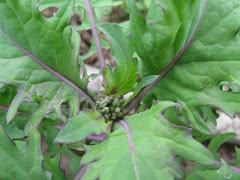
Nipplewort - (Lapsana communis) Now here is an edible weed that first showed itself in my garden two years ago, at first I fought it, mostly because for the life of me I couldn't figure out what it was, now I know, now we eat it.:) Seems to be very cold hardy and something I will be making much better use of in the future. Here is a
recipe for this prolific plant.
Onions/Chives/ Garlic greens - Egyptian, scallions, garlic, and various chives will all provide one with more than a few nice shoots during the winter months. Our chives usually fade away in the winter but are one of the first greens to appear again in early spring. Planted early spring.
Parsley(we use curly leaf) - Very cold hardy well into the winter. Sometimes there are issues with mold but most plants provide us with greens all winter long. Planted early spring.
Pea greens - We have often grown fall planted pea greens to serve as an addition to our salads well into mid December as they can often handle temperatures in the low to mid 20's.
Plantain (various) - Not the tastiest green around but they certainly are hardy and resilient.
Prunella - Still experimenting with this plant but it does seem to be quite indifferent to the cold and is another healthful spinach substitute.
Radish - We can't seem to grow a decent root no matter what we try but the greens will hold out well into winter. Planted late summer.
Rutabaga - Left in the garden, rutabaga will often lose its larger leaves but put out new growth during any warm periods. Some of the roots do rot but others manage the winter quite well. Planted in the spring or summer.
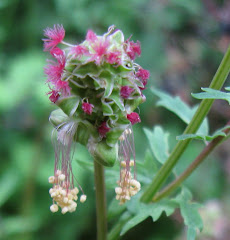
Salad Burnet - Needs nothing but a little snow to protect it. Planted in early spring.
Scorzonera - These perennial plants can be used for the roots or greens and are quite tolerant of the cold. Planted in early spring.
Sorrel - Our knowledge lies with overwintering French and Red Veined sorrel, both of which are extremely cold hardy. Planted in early spring and cut back after flowering or planted mid summer. Sheep and Wood sorrel make for nice spring greens but we have not purposely tried to use them during the winter months, although I would imagine that if planted at the proper time, before they are able to set seed, they would also prove to be useful.
Sowthistle (smooth/annual) - While not for everyone we enjoy the purplish colored leaves of this hardy plant in our early winter and summer salads. Planted mid to late summer.
Spinach - The Bloomingdale variety has done well for us, often providing greens all winter long. Planted mid to late summer depending upon the weather.
Turnip - We grow both Seven Top and Purple Top for their greens but are often surprised with small Purple Top turnips come spring as both these plants have an insatiable will to grow given any period of warmth, even in the depths of winter. Planted late summer.
Violets - I'm not sure about all of them but the wild purple flowered ones and violas that we grow can be picked and plucked for their mucilaginous leaves all winter. They are most efficient at planting themselves.
Common garden sage has no qualms about enduring wintry conditions

Most of our winter gardening experience lies in using plastic covered low tunnels and cold frames to protect the crops. Here are some links on various design tutorials that come to mind. More examples of cold frames, greenhouses, and hoophouses can be found on my sidebar.
Our own simple row covers (zone 5b)
Dan McMurray's row covers (zone 6/7)
Laura's row covers (zone 8b)
Thomas's mini hoop houses (zone 6a)
Herrick Kimball's whizbang row cover hoop system (zone 5a)
Eliot Coleman's quick hoops (zone 5)
Susy's garden hoops (zone 5)
Dave's cold frames (zone 6b)
Susan Robishaw's stackable cold frames (zone 4) - Sue also has a booklet out called
"Frost Dancing - Tips from a Northern Gardener" that I have yet to read.
Another convenience of covered rows in a northern garden is access to thawed soil for planting early in the season. We are often able to direct seed or transplant spring greens even with a slow to melt covering of snow still on the ground. After a continuous 122 days below 40°F (4.44 °C) we started to get a bit antsy to get growing in this March 20th 2009 picture, the ground under the row covers remains warm to the touch while the surrounding earth is still partially frozen and covered in dirty white.

Here is a list of interesting reads on the subject of winter or cold climate gardening. Some deal more with cold hardy summer vegetables for northern gardens than actual winter crops but they all impart valuable information. The first three authors are the ones that focus the most on actual winter crops. I would love to hear any other suggestions for books to read on this subject.
Winter Gardening In The Maritime Northwest: Cool Season Crops For The Year-Round Gardener by Binda Colebrook
Four-Season Harvest and
The Winter Harvest Handbook by Eliot Coleman - See how Eliot Coleman grows his crops at -
http://www.youtube.com/watch?v=cBKr9kPrpzU
The Year-Round Vegetable Gardener: How to Grow Your Own Food 365 Days a Year, No Matter Where You Live by Niki Jabbour - See more of her at -
http://yearroundveggiegardener.blogspot.com/
Successful Cold Climate Gardening by Lewis Hill
Building And Using Our Sun-Heated Greenhouse: Grow Vegetables All Year-Round by Helen and Scott Nearing - See them in person at -
http://www.youtube.com/watch?v=Czr3iJBY4z0&feature=related
The Solar Greenhouse Book edited by James C McCullagh
The Victorian Kitchen Garden by Jennifer Davis - An inspiring video series on this can be seen at -
http://www.youtube.com/watch?v=XXO4mAY8tGI
The New Northern Gardener by Jennifer Bennett
Organic Gardening in Cold Climates by Sandra Perrin
Growing Vegetables West of The Cascades by Steve Solomon - See the author at -
http://www.youtube.com/user/Padresolvideos#p/u/20/IzNL2chyId4 and
http://www.soilandhealth.org/05steve%27sfolder/05aboutmeindex.html
Greening The Garden A Guide To Sustainable Growing by Dan Jason (I love the philosophical aspect of this book) - There is an excellent video series on him at -
http://www.youtube.com/watch?v=nMjGg9GeKPk
We begin setting up our hoops in early October just before the first frosts. This one contains Russian kale.

Some speculation. According to various sources increased potassium levels in the tissue of plant leaves "might" help to protect them during adverse weather conditions. Potassium is said to have a
beneficial effect on how a plant assimulates or uses water and also
aids in photosynthesis. Since frost damage often results from the dehydration of leaf tissue, increasing potassium could lead to better photosynthesis and acclimatization, thus protecting it from frost to a certain degree. While I have found no conclusive studies to back up this "cold hardiness theory" we do supply our garden, especially the winter crops, with plenty of potassium via wood ash as plants deficient in this mineral certainly would be more prone to cold weather damage.
Row of this year's Dwarf Curly Leaf kale

More speculation. Per
a local climatologist that I follow, "Climate researchers at the University of Washington in Seattle recently said that their climate models are predicting increasing precipitation in the next decade in the northern latitudes. This should mean more snowy winter seasons across the Inland Empire and other regions of the U.S. near the Canadian border." Also, "European, Russian, and Japanese scientists are each predicting an increase in global cooling and expanding glaciers worldwide by 2014."
Check out this "cool"
global temperature chart.
If this is true, both summer and winter gardening conditions will continue to prove increasingly challenging and having a good grasp on how to grow one's own food under these less than desirable circumstances will be of the utmost importance going forward. The snow in the pictures below has since dissipated as the weather warmed a bit last week, but it has once again started to cool off in the 20° and 30° range...I would have prefered to have kept the insulating coverage of snow but nature does not consult with me on such things.:) It will be interesting to see what the next couple months of winter will be like?
Purple and Seven Top turnips are one of our most important winter greens, some of them are already producing little turnips.