The tree I'm cutting on in this photo is a Grand Fir, Native Americans used the inner bark of this tree for treating colds and fever...interesting.
Friday, October 28, 2011
Next Year's Firewood
The tree I'm cutting on in this photo is a Grand Fir, Native Americans used the inner bark of this tree for treating colds and fever...interesting.
Labels:
firewood
Monday, October 24, 2011
Potting Up Celery & Little Willie
Still frost free and our celery is potted up. In a another week or so it will be transferred to the root cellar for the winter, providing us with tasty stalks and leaves throughout the snowy months. Each pot contains 3-4 plants, 1/3 of whose foliage, preferably the less than desirable ones, are removed to compensate for root disturbance during the potting procedure. Only healthy plants that show no sign of bolting (sending up a round central stalk) to seed are chosen for winter storage. Most plants will not only survive the winter in our root cellar where they will continue producing, albeit somewhat more pale in comparison to the ones produced under sunlight, but can be planted back out into the garden in early spring for more fresh greens and eventually seed from chosen plants.
A new variety that we grew this year called Crisp & Tender, thanks to the seedy generosity of the kind soul at Kabun-Malay Kadazan girls blog, was a big hit with us. Unfortunately, we did not place it in the most ideal location as it was the last batch of celery planted this past spring and wound up in a slightly drier and shady location at the end of the row under a fir tree. Even so, the plants provided us with a plethora of slender and surprisingly dark green flavorful stalks...for sure we will be growing this variety again next season. We also grew Ventura, Giant Red, Utah, and a leaf celery called Parcel.
Sweet & Tender celery, all the way from Australia, thrived in our cool shady garden.
Labels:
forcing,
harvesting and preserving,
pets,
root cellar
Tuesday, October 18, 2011
Michael Pilarski - Forest Gardens
Michael Pilarski is a wellspring of knowledge when it comes to creating edible forest gardens.
See more of Michael Pilarski at -
https://www.youtube.com/results?search_query=michael+pilarski&suggested_categories=27%2C28&page=1
and
http://www.friendsofthetrees.net/
See more of Michael Pilarski at -
https://www.youtube.com/results?search_query=michael+pilarski&suggested_categories=27%2C28&page=1
and
http://www.friendsofthetrees.net/
Labels:
video
Thursday, October 13, 2011
Harvesting Beets & Greens
Beets were harvested this week and we were quite pleased with the results, about 70% of them filled out nicely, the rest were either damaged by mice or too small to bother with. Pictured in the cooler are some of the better looking greens that were set aside to be blanched and frozen. Interestingly, your average beet is supposed to take 55-80 days from the time it germinates to maturity, mine normally take between 90 and 120 days. The above beets were planted in mid-May and just recently reached a harvestable size.
The mice damage was my own fault, I should have been paying better attention and either hilled dirt around the roots in early September or set out mouse traps as this is often an issue we face in the fall. Near as I can tell the mice will not dig for roots and only snack on the parts remaining above the soil which makes beets, and sometimes carrots, an irresistible target for them. Gonna have to have a little chat with those cats about earning their keep...one of them even lives in our greenhouse during the summer and has apparently not been doing as good a job at rodent control as I had thought.
After harvesting, the tops are trimmed leaving about an inch of stem remaining, keeping some of the stem intact helps to keep them from spoiling. They are then placed into totes and coolers, layered in ever so slightly damp sandy soil, and stored in our root cellar. Beets are one of our longest storing root crops, some remaining in excellent eating condition for well over a year. This year's crop included Detroit Dark Red, Crosby's Egyptian, Lutz, Cylindria, Crapaudine, Boltardy, a few golden beets whose name slips me, and a new to us variety called Red Cloud (hybrid) that performed extremely well this year...wish I would have grown a few more of those.
Labels:
harvesting and preserving
Thursday, October 6, 2011
The Harvest Season Is Upon Us
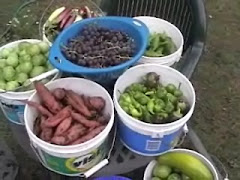
We track the weight of our tomatoes, potatoes, and onions to help us evaluate production, that coupled with the fact that since these crops are gathered in five gallon buckets it is just too easy not to.
This year's potatoes were planted fairly intensively and yielded around 6-8 tubers per plant. They were planted 12" deep and I did not "hill them up" at all this summer. Because we have chosen to keep our aisle ways so very narrow, practically disappearing by mid-summer, it is difficult for me to hill up potatoes so I have found that deep planting makes up for this in our garden.
In 2012 I hope to experiment with more of a dryland farming technique with some of our potato crop that involves depending upon using only natural occurring rain water, wide spacing, and dirt/dust mulch to help with water retention. This will be done in an area separate from our main garden, we have a 3 acre field that is not cost effective to irrigate and need to start putting it to good use with something besides knapweed. For quite some time now one of my concerns has been that we are far too dependent upon irrigation and I would like to learn more about growing crops with less water and potatoes would seem to be a great dryland crop to experiment with. A fellow blogger , in a somewhat similar climate, has had great success with this type of farming and it would seem to be a much more sustainable manner in which to grow crops allowing us to shed some of our dependence on water pumped to us via electric power.
Our goal is to get an average yield of 5-10 lbs per plant, some will provide many more fruits some less. We grow a variety called De Tiganesti that provided nearly 20 lbs per plant whereas our Black Krim and Coastal Pride varieties only shared 4-5 tomatoes per plant with us...but their flavor more than made up for the lack of productivity.
Labels:
harvesting and preserving
Thursday, September 8, 2011
Tomatoes
With the continuation of warm daytime temperatures and dry weather our tomatoes are finally starting to come into their own. Looks like the plants will produce a little better than I had originally thought if this warm weather holds out for another week or so. With hot days and clear cold nights frost has been showing itself in our bottom field so we will have to be diligent in watching the temperatures and pick all of the tomatoes ripe or not at the last minute as is usual for us this time of the year. Luckily our tomatoes are grown up the hill and under the protection of the trees which gives us a good 3-5°'s of leeway. Here are a few that I noticed on my way out of the garden last night.
Bursztyn is always a favorite with its very sweet yet tangy flavor.

Still waiting for Miracle of the Market to produce a ripe tomato but the fruits are filling out nicely. (Thanks Annie's Granny:)

Persey is another new to us variety (again, thanks to Annie's Granny) that has been performing well...we have been eating quite a few of these the past couple weeks.

Silvery Fir Tree continues to surprise us, the foliage is all but gone while the tomatoes finish ripening. Each plant of this variety I grew produced around 15 - 16 nice tomatoes...not bad for such a shrimpy little plant.
Bursztyn is always a favorite with its very sweet yet tangy flavor.
Still waiting for Miracle of the Market to produce a ripe tomato but the fruits are filling out nicely. (Thanks Annie's Granny:)
Persey is another new to us variety (again, thanks to Annie's Granny) that has been performing well...we have been eating quite a few of these the past couple weeks.
Silvery Fir Tree continues to surprise us, the foliage is all but gone while the tomatoes finish ripening. Each plant of this variety I grew produced around 15 - 16 nice tomatoes...not bad for such a shrimpy little plant.
Labels:
garden
Monday, August 29, 2011
Sweet & Spicy
Our second crop of strawberries is coming on, not too many yet but they are of nice size and flavor. The ones above ended up in a smoothie...it was good.
I have been busy making our version of kimchi, the latest batch consisted of cucumbers, green beans, carrots, various cabbage, Tuscan kale, kohlrabi, Italian chicory, red amaranth leaves, onions, garlic, chives, green onions, green & black peppers (would have liked to have had some red peppers for color), and was flavored with spicy red pepper powder, paprika powder, plus a few tablespoons of grated ginger.
For every five pounds of processed veggies I added a very light 3 tablespoons of sea salt. The cabbage is mixed with the salt and pounded to release juices. I then included the rest of the veggies and spices, mixed well and packed into a crock, keeping the ingredients weighted down for approximately a week. One cup of water was also used in order to have enough brine to cover everything. Seven days later I transferred the fermented deliciousness into glass jars...15 lbs of veggies made 1 gallon plus a quart.
This can either be kept in a cool root cellar or one's refrigerator. Since I had to make it early this year in order to incorporate fresh green beans and cucumbers into the mix it is being stored in the refrigerator as the root cellar is not quite cold enough yet...last year our kimchi and sauerkraut stored well in the root cellar from October through May at which time I put the remaining jars in our refrigerator. It will easily keep over a year this way, we are still working to finish off last year's kimchi and it tastes just fine.
In looking at these jars I am reminded that a piece of wax paper should be added in order to keep the lids from corroding or rusting...oops.:) Also, after the first week or so in storage we always have to add a little more brine to keep everything covered.
Does anyone else enjoy the bold flavors of kimchi?
Labels:
good eats,
harvesting and preserving,
root cellar
Monday, August 22, 2011
The Agro Rebel
"Nature's book always contains the truth; we must only learn to read it." - Sepp Holzer
I have been following the farming methods of Sepp Holzer for quite a few years now but only recently finished reading his most interesting book titled Sepp Holzer's Permaculture - A practical Guide to Small Scale, Integrative Farming and Gardening. The book is a fascinating account of how Austrian farmer Sepp Holzer has, over the past 40 years, transformed his over 100 acres of steep mountain sides into a virtual paradise filled with fruit trees, vegetables, and free ranging animals like the wooly Mangalitza, endangered Turopolje, and other pigs he uses to help clear and till the land.
Diversity instead of monoculture and working with nature rather than against it has allowed him to build a farm that thrives at altitudes ranging upwards of 5,000 ft above sea level with an average (mean) temperature of 39.5°...similar to the average in Duluth MN but with slightly warmer winters.
It's really quite amazing what he has accomplished in this boreal climate. Over 30,000 fruit trees, including citrus, apricot, peach, eucalyptus, fig, and kiwi fruit varieties, dot the landscape. His cherry harvest extends from June all the way into October because the trees are grown at varying altitudes. The Holzer family also enjoys working with unusual crops like primeval grains, mushrooms, and even raise fish in some 70 plus ponds that Sepp has created over the years...the epitome of permaculture. Take a look at the video below and you will see what I am talking about.
(Ohiofarmgirl - pig tilling can be seen at 40:45 minutes)
The movie can be viewed in a larger format at the below link↓...warning, if your computer is as pitifully slow as mine it might be hard to load.
More information can be found at -
http://video.google.com/videoplay?docid=727825431796194016
http://www.perma-dise.com/download/SeppOffener_English.pdf
http://www.richsoil.com/sepp-holzer/sepp-holzer-permaculture.jsp
And his previous book - The Rebel Farmer
Labels:
video
Subscribe to:
Posts (Atom)